|
Austin, Texas marketing@PlasmaGasification.com
|
|
Austin, Texas marketing@PlasmaGasification.com
|
Plasma
Gasification
www.PlasmaGasification.com
What
is "Plasma Gasification?"
Plasma Gasification - is the thermal disintegration of carbonaceous materials into their elemental compounds in an oxygen-starved environment using a "plasma."
Plasma Gasification renders most waste streams, including medical/hospital waste, chemical waste, hazardous waste, and even low-level radioactive waste, completely safe and inert. Plasma Gasification is the "ultimate" solution for handling most every waste stream that is now going into landfills.
While there are, at present NO Plasma Gasification in commercial operation in the USA, we believe that some day, whether 5 years or 25 years, that Plasma Gasification plants will be located next to landfills, and take the waste that would have gone into the landfill, and be processed by Plasma Gasification. Eventually, the waste and contents of landfills will be recovered and processed with Plasma Gasification plants.
|
Enhanced Oil Recovery * Gas EOR * Reservoir Stimulation * Solar EOR * Sewage Sludge Steam Injection * Synthesis Gas * Upstream Oil and Gas * Waste To Energy * Waste To Fuel
|

"Changing the Way the World Makes and Uses Energy" SM
For Advertising, Business Development, Marketing
or Sales solutions, call or email:

marketing@PlasmaGasification.com
The following information about Plasma Gasification, in part, from Department of Energy.
What
is Plasma?
Plasma, referred to as the "fourth state of matter," is a very high
temperature, highly ionized (electrically charged) gas capable of conducting
electrical current. Examples of plasma in nature include lightning and gas at
the surface of the sun. Plasma technology has a long history of development and
has evolved into a valuable tool for engineers and scientists who need to use
very high temperatures for new process applications. Man made plasma is formed
by passing an electrical discharge through a gas such as air or oxygen (O2).
The interaction of the gas with the electric arc dissociates the gas into
electrons and ions, and causes its temperature to increase significantly, often
exceeding 6,000 °C, nearly as hot as the sun’s surface.
show a schematic drawing and a picture, respectively, of a plasma torch used to generate plasma. The plasma torch can be fed with process gases of various chemical composition including air, O2, nitrogen (N2), argon and others, allowing the process to be tailored to specific applications.
Plasma
Gasification and its Potential Advantages
Numerous companies have been developing plasma gasification technology to treat
multiple waste streams including industrial and municipal solid wastes (MSW)
over the last decade, and recently has been investigating the application of
their plasma technology to gasifiy coal. They believe their technology can be
demonstrated to gasify coal in an ambient pressure, plasma-fired reactor that
can be retrofitted into existing power plants and/or installed as a new
facility, with the following potential benefits over a pulverized coal power
and/or conventional gasification plant:
Greater waste stream feed flexibility which enables coal, coal fines, mining waste, lignite, and other opportunity fuels (e.g., biomass and MSW) to be used as fuel without the need for pulverizing
Air blown and thus an oxygen plant is not required
High availability (>90%)
High conversion (>99%) organic matter to synthesis gas (syngas)
No tar in syngas; syngas of approximately 140 Btu/scf for air-blown design suitable for syngas combustion turbine operation after gas cleanup
No char, ash or residual carbon; only producing a glassy slag with beneficial value
Compliant with EPA New Source emissions standards for nitrogen oxide (NOX), sulfur oxide (SOX) particulates, etc.
Higher thermal efficiency
Lower carbon dioxide (CO2) emissions
Low estimated capital and operations and maintenance (O&M) costs
What is Enhanced Oil Recovery?
Enhanced Oil Recovery or "EOR," also referred to as tertiary recovery or tertiary oil recovery, is the 3rd and final stage of oil recovery.
When an oil well is first completed and oil production begins, this is called the primary oil recovery stage. Anywhere from 5% to 15% of the "original oil in place" (OOIP) in the oil well's reservoir is recovered via "natural" reservoir drive, meaning natural forces drive or displace the oil into the production well's well bore.
The secondary oil recovery stage is where additional production measures are installed wherein anywhere from 10% to 30% of the original oil in place is recovered.
When the secondary oil recovery stage is complete - and ready for Enhanced Oil Recovery - 55% to 85% of the original oil in place remains.
The Department of Energy and many industry experts are on record in stating that Enhanced Oil Recovery has the potential to recover up to 60% of the remaining 55% to 85% - which means that Enhanced Oil Recovery has the potential to recover up 300 Billion barrels of oil. At $100/bbl, Enhanced Oil Recovery represents a $30 Trillion market opportunity (in the U.S.A.).
* EOR Technologies is a new company that is presently being formed by a top EOR engineer and EOR Professor at one of the top-ranked Petroleum Engineering schools and an energy professional with 25 years experience & MBA.
Two
recent studies document the explosive growth in the
Enhanced Oil Recovery market:
1. Enhanced Oil Recovery Market Valued at $126.02
Billion/year (2012) with Gas
EOR and CO2-EOR
technologies leading the Growth for the EOR Industry
http://www.marketwired.com/press-release/enhanced-oil-recovery-market-valued-at-12602-billion-gas-co2-leads-growth-sbi-energy-1678405.htm
2. Global
revenues from
Enhanced
Oil Recovery production now exceed one trillion
dollars/year. According to a recent report from energy research publisher SBI, the market for worldwide
Enhanced
Oil Recovery production will reach $1.3 trillion/year by 2015.
http://www.sbireports.com/about/release.asp?id=2863
The
United States will recover more than 300 Billion Barrels of Oil through
Enhanced
Oil Recovery (EOR) technologies according to the Department
of Energy.
With oil priced at $100/bbl, EOR represents a $30 Trillion market
in the USA
In the next 10-15 years, 50% of the oil produced in the USA
will be through Enhanced Oil Recovery technologies.
And 50% of this amount will be produced by CO2-EOR.
The Enhanced Oil Recovery
industry represents a $30 Trillion market,
(in the USA) with oil priced at $100 per barrel.
Enhanced
Oil Recovery technologies would solve our trade deficit
problems, create thousands of new jobs, and save the U.S. economy
almost $400 billion/year and end our reliance and dependence on
foreign oil suppliers. At the same time, sequester billions of
tons of Carbon
Emissions, as Carbon Dioxide is used in producing
previously non-recoverable oil.
When an oil well or oil field reaches the end of its normal life, as much as
75% of the "original oil place" is still left underground in the oil
wells. That's because recovering previously non-recoverable oil is either too difficult or too expensive, or both. It has been estimated that by recovering just 1% of the
previously non-recoverable oil through Enhanced
Oil Recovery technologies, that this would
produce about 30 billion additional barrels of oil.
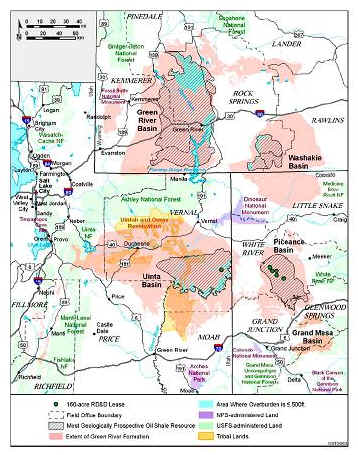
The
DOE estimates Colorado and Wyoming have
1.8 trillion barrels of oil that can be recovered with
Steam Injection - an EOR technology
America
Needs America's Oil!
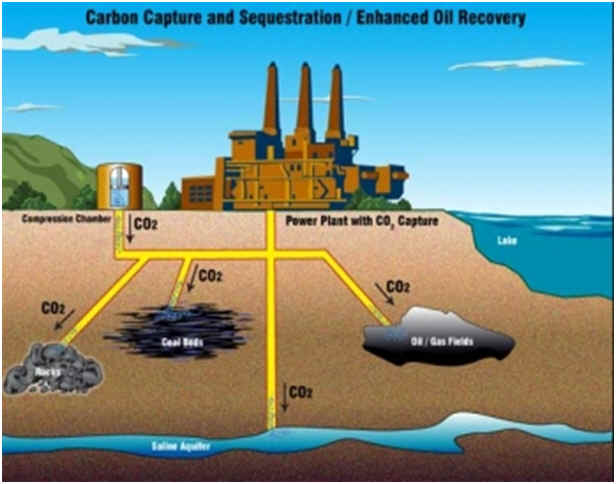
What are the various EOR
Technologies?
EOR Technologies describes a growing number of Enhanced Oil Recovery technologies used to recover oil in the third and final stage of oil production. Oil recovered in this stage may come close to or possibly exceed the oil that was produced in the primary and secondary stages. A few of the leading (and emerging) EOR technologies include:
ASP flooding
Chemical EOR
Chemical Flooding
CO2-EOR
CO2 Flooding
CO2 Injection
Gas-EOR
Gas Flooding
Gas Injection
Heavy Oil Recovery
Microbial EOR
Miscible Gas Flooding/Injection
Nitrogen Injection
Polymer Flooding
Polymer Injection
Solar EOR
Steam Injection
Surfactant EOR
Surfactant Flooding
Thermal EOR
Over the past forty years, the enhanced oil recovery industry has produced a number of excellent and proven EOR technologies.
However, the optimum EOR technology for any one particular client with declining oil production, is dependent on a number of variables that must be identified and understood before selecting the correct EOR technology, including;
Specific oil reservoir type / condition
Depth of pay zone
Interfacial tension or IFT ( displacement efficiency)
Mobility control (sweep efficiency)
Oil composition
Oil gravity
Oil reserve
Overall condition of well
Permeability
Porosity
Reservoir's brine (salinity NaCl) content
Reservoir's temperature
Working condition of reservoir
among others. The "optimum" EOR technology for one reservoir and pay zone may not be the optimum EOR technology for another - even within the same oil field. That's why we are "EOR technology neutral." We apply the optimum EOR technology for each client's specific requirements for maximizing our client's oil recovery, at the least possible cost.
Enhanced oil recovery represents a significant opportunity for companies with declining oil production to significantly increase their oil production and revenues through our range of EOR technologies and services.
How much more oil can we produce from our "mature" oil field and wells?
Enhanced oil recovery or "EOR" represents a significant opportunity for companies with declining oil production to significantly increase their oil production and revenues through our range of EOR technologies and services.
As seen above, there are a number of variables that determine the potential increase in production for any particular application.
With that said, some of the EOR technologies can have a significant reversal in oil production.
Would increasing your oil production from 20 bbls/day to 40 bbls/day for a 100% increase in oil production make a difference in your company's bottom line?
The
EOR industry's technologies' products, services and capabilities include:
ASP flooding
Chemical EOR
Chemical Flooding
CO2-EOR
CO2 Flooding
CO2 Injection
Energy Investment Banking
Enhanced Oil Recovery
EOR Conference
EOR Technologies
Gas-EOR
Gas Flooding
Gas Injection
Heavy Oil Recovery
Hydraulic Workover
Microbial EOR
Miscible Gas
Nitrogen Injection
Petroleum Engineering
Polymer Flooding
Polymer Injection
Reservoir Engineering
Reservoir Stimulation
Snubbing Services
Solar EOR
Steam Injection
Surfactant EOR
Surfactant Flooding
Thermal EOR
Tracer Testing
Upstream oil and gas acquisitions
There can only be one "optimum" EOR solution per well/reservoir or mature oil oil field. EOR Technologies identifies that EOR solution to insure the maximum oil production for the least cost for our clients. Note: EOR technologies, products and services may be provided in part or in whole by affiliated companies or partner companies. Call/email us today for an initial consultation to discuss your declining oil production problems.
* Note: Increased oil production results vary due to a number of factors including oil well, oil field, reservoirs and operating conditions of the well and reservoir. EOR results will vary. EOR technology deployed may be provided in part or in whole by partner or affiliate companies.
Enhanced Oil Recovery revenues nearly
DOUBLED,
in just 4 years from $54.96 billion in 2007 to
$102.02 billion in 2011!
CO2-EOR
/ Gas-EOR
technologies lead all other
EOR
Technologies
with 43% market share.
We deliver
solutions:
Acquisitions
Advertising
Business Development
Capital Access
Divestments
Engineering
EPC
Marketing Strategies
Investment opportunities
Investor inquiries
Project Development
Public Relations
Sales Solutions
Strategic Marketing
That produce results:
Increased
sales
New
customers
Greater
market share
Competitive advantage
Increased
shareholder value
American Energy Plan
sm
www.AmericanEnergyPlan.org
* 3-5 million new jobs
* Fuel Savings of > $1.50/gallon
* American Energy Independence
* Ends the worst economic depression of all time

Support America's Domestic Oil and Gas
resources and companies
Energy
Investment Banking
___________________________________________
www.EnergyInvestmentBanking.com
Enhanced
Oil Recovery
___________________________________________
www.EnhancedOilRecovery.com

NO FOREIGN OIL!
“spending
hundreds and hundreds and hundreds of billions of dollars every year for
oil, much of it from the Middle East, is just about the single stupidest
thing that modern society could possibly do. It’s very difficult to
think of anything more idiotic than that.”
~
R. James Woolsey, Jr., former Director of the CIA
According to R. James Woolsey, for Director of the Central Intelligence Agency, “The basic insight is to realize that global warming, the geopolitics of oil, and warfare in the Persian Gulf are not separate problems — they are aspects of a single problem, the West’s dependence on oil.”

American jobs. American Energy Independence. Keep the 1/2 Trillion dollars in America we now send to OPEC and foreign countries each year to buy the oil America needs. And most importantly, to save the lives of America's brave soldiers, sailors and airmen fighting & dying for muslim oil.
#PlasmaGasification


"Changing the Way the World Makes and Uses Energy" SM
Plasma
Gasification
www.PlasmaGasification.com
For Advertising, Business Development, Marketing
or Sales solutions, call or email:
marketing@PlasmaGasification.com
PlasmaGasification.com
Copyright
© 2003
All Rights Reserved
